Friday, October 20, 2017

The "B" word

I read an article earlier this week, which informed me that I was almost at the point where I would be considered “mid-career.” I quickly dismissed this with disgust since for one, grad school was just yesterday, and furthermore I still consider myself young, hip and fresh in the field. Who wants to play pop up pirate with a “mid-career” therapist? 

I thought about it for a bit, and decided it meant that maybe, just possibly, I might be able to share a few choice words of wisdom about what I’ve learnt along the way as I hit my 8th year (see not that bad) of practice. I’ve spent all of those years building a private practice. However in Barbados, where you’re one of four speech pathologists it means that you’re also a school SLP, medical SLP, community SLP… and the list goes on.  Needless to say I’ve learnt a few things in each area thus far. The key topic that pops up weekly in conversations with colleagues and interns is “avoiding BURNOUT.” Yes that dreaded "B" word that can creep up on even the best of us. 

Disclaimer: I in no way consider myself an expert in the field. I still struggle with clients, still have mini panic attacks when I think about scheduling and caseload management, still suffer from imposter syndrome sometimes, still have to google SLP terminology or “phone a friend,” still some days fantasize about marrying filthy rich and sailing away from paperwork mountains on a massive yacht…but I digress. The important thing is that I’m still here, and still loving what I do every step of the way.

What are my tips for waking up every most mornings still excited to go to work?

Unleash your creativity (or at least Pinterest’s creativity)

Sessions can get boring very quickly, not only for your clients, but for you as well. I don’t know a single therapist who has said “I can’t wait to use those same flashcards in therapy for the 10th time!” Fortunately for our field the SLP world has taken over technology, and the internet is filled with a plethora of blog posts, pinterest ideas, TPT stores and other wonderful places, that place creative new ways to hit your targets at your fingertips. Also remember you’re not limited to your therapy room (I feel claustrophobic in clinic after a while). Take it outdoors, to the playground, to the supermarket, even to the corridor or another room. A small change of scenery goes a long way. Speaking of a change of scenery…..

Get Away

Yes I said step away from the laminator and book a trip somewhere. It could be to a convention or continuing education course, where you have the opportunity to network with likeminded professionals and come back to work with fresh ideas and new skills to use with your clients. It could also be just a quick trip somewhere to clear your head and regroup. I find that I get the best ideas and make the clearest decisions for my practice when I’m as far away as possible from said practice. Sometimes we get so bogged down and caught up in everything that is happening with our caseload that we don’t have time for brainstorming or problem solving, and we end up digging ourselves into a burnout hole. Trust me…step away for a bit.

Delegate
I cannot tell you the last time I have filled out an insurance form, written a receipt, or touched a laminator. These are all things that had to be done on my own when I first started work. However, as soon as I could find someone to delegate admin type work to, that was quickly passed off so I could focus on doing therapy. I’m also working on passing on certain clients and tasks to my newgrads, as soon as I decide that they are competent enough to manage.  I will admit that it is extremely hard to do, especially if you’re used to managing everything, but it definitely makes life easier. You do not have to oversee every visual timetable printed!

Share your knowledge
I’ve been a clinical supervisor for just about four years now, and though there are some interns who make me pull my hair out, having them always makes me see my work from a fresh new perspective. Furthermore, they usually come with the latest research and therapy ideas, and provide new insight into what is current best practice in the academic world.  I’ve also realized that every time I talk about, and demonstrate how and why I do what I do I fall in love with the field all over again. This also applies to teacher/parent/paraprofessional training. Sharing your knowledge and skills allows for great moments of self-reflection, critical thinking, and problem solving. Most importantly you are equipping new minds with the tools needed to go out and make an even greater difference in the world.

Jack of all trades, master of burnout  
This should be the title of my article. When I left grad school I was so excited to learn everything about everything in the field. In the first years I did Hanen, PROMPT, SOS Feeding, Auditory Verbal, AAC courses, Dysphagia training, and the list goes on. My thinking was that I didn’t want anyone to show up at my clinic, and I didn’t have the skills to help them. Sounds heroic, but not at all practical. I felt like I was dying from information overload, like I wasn’t particularly good at anything, and I started to feel unfulfilled in the field. After a few years (maybe about 6….it was tough) I decided to focus on key areas which I was passionate about and be amazing(ish) at those. The main ones for me have been Autism and Augmentative and Alternative Communication (AAC), which both tie in quite closely. I’ve also been more interested in feeding, but I haven’t delved into it fully. I’m not going to say I don’t do the odd modified barium swallow when needed, or work with a speech sound disorder. However they’re not my primary areas of focus, and I’m hoping that soon I can delegate those too.

Ask for Help
When I first moved home after grad school I found out what it was like to work in a country with very few therapists, and limited resources. To say it was tough would be an understatement. Remember this was before pinterest and TPT days! I reached out and started doing lots of networking via twitter, where I learnt 100 times more than what I learnt in grad school and picked up quite a few mentors along the way (Mentors are absolutely essential to your practice). It makes no sense (nor is it ethical) fumbling around in the dark and not seeking best practice for your clients. Reach out to the #slpeeps on twitter, the many facebook groups now available for various clinical populations, or the ASHA Special Interest Groups, and ask for whatever support you need. It also doesn’t hurt to email an old lecturer, or someone who did a presentation at a conference/webinar you attended. Trust me it works.


Take off that cape sometimes
Yes I mean you superwoman(man)! I see you balancing that million client caseload, making sure everyone has their visuals,  that IEPs and progress reports are submitted; trying to figure out how you’re going to stop in before gym to make sure those parents are really doing family meals for dinner, and sneak out before you have to give advice again on how to get the older brother to do his homework. I know you’re putting your phone on bluetooth on the way to pick up groceries, so you can explain the results of last week’s evaluation, and yes of course you’ll give a talk this weekend at his preschool’s PTA meeting….but wait did you even eat lunch today??
After a few more of those panic attacks I mentioned, I had a conversation with myself one day and said “You cannot be everything to everyone!” It’s impossible, and as much as we want to do everything in our power to help our clients, we have to be something for ourselves….Even if that means saying no sometimes. This does not make you any less of a therapist or any less of a person. It shows that you know your limits, and value your sanity.  This is still a work in progress for me, but trust me I’ve gotten so much better at saying “no” in so many ways, I’m no longer feeling like the most overworked person in the world and my life has been a better place because of it.


I hope these words of wisdom from an “almost mid career therapist” will help to make some impact on your practice. One more quick tip to leave you with....

Never, ever forget to have fun; when it stops being fun it means we have to do something to find our magic again. 


Feel free to share what works for you as well.


Friday, July 22, 2016

Bringing Therapy to Life

I think I can safely say that summer is the time that rekindles my love for what I do. It also highlights my appreciation for the flexibility of having my own practice. Instead of packing my suitcases and headed off to the next trip (hopefully that happens in September), the last days of June are spent with my planning team, sitting on the floor of my office trying to think up the most awesome ways to make summer groups functional, interactive, and most importantly FUN.  As part of my self diagnosed ADD I absolutely hate to be confined to the clinic, so I try to incorporate as many outdoor activities as possible. Summer groups have been sooooo much fun thus far! The little ones have been having a blast and really building their language skills and it's such a beautiful thing to watch them shine within the group setting. My favorite group activity so far has been our community helpers day with our Language Building.

Just before summer started most of the little ones in this group were working individually on community helpers vocabulary, as well as responding to "who" questions. To start the group session we reviewed the community helpers worksheet from Black Sheep Press, and the little ones got a quite a surprise when some of these helpers showed up one by one at the clinic.


The policeman was clearly an undercover speechie, since he took everyone's worksheet and asked them to point to the policeman, asked them to find the different parts on his bike and shout them out...it was amazing.

Just when they thought it couldn't get any better, a huge firetruck came around the corner, complete with 3 real life firemen. They got to see and label all the different parts of the firetruck, climb on, hear the siren...it was perfect. This speechie was on cloud 9.


I am so grateful to the members of the Barbados Fire Service and the Royal Barbados Police Force for helping make this happen. It was truly an amazing experience, and language learning opportunity.

Stay tuned for more of what's happening in summer groups!

Thursday, April 7, 2016

What does Baking have to do with AAC?

I've discovered a love for baking. My pinterest page is filled with the most delicious looking cakes, breads, muffins and all sorts of dough filled goodness. I even made the investment and bought a kitchenaid stand mixer a few weeks ago. Now I can't stay out of the kitchen (or the gym for that matter...sigh). It has become a bit therapeutic for me as well. If I have a bad day, I bake. My neighbors and friends are quite happy with this new hobby.

My love has also been rekindled for AAC. Don't get me wrong I never stopped using it in my practice; there were just some periods when it all felt a bit overwhelming... However it's important to note as a therapist that when you stop having fun with AAC your clients will as well. So I started having fun with it again. My AAC goals moved away from being focused primarily on choosing specific language/ vocab targets, and became more about fitting those targets into clients' interests.
So we started going on treasure hunts, and having afternoon tea....and Baking...yes we started baking.

When I first introduced the concept of AAC to an older client about 3 years ago her response was quite a lackluster one. Actually it was more like BLEH! And to be honest I don't blame her. In her shoes I would have had that reaction too. It was boring, it was something new to learn, it wasn't motivating. All I was thinking of then was "Hey, I'm giving you a voice (sounds familiar?), you should want to use it, right?" Wrong! It wasn't working. We tried a few other things and well...bleh! Then one day I introduced her to pinterest on her iPad, and at that moment the heavens opened up, a light shone down, and I had opened the gates of technology. I followed her, she followed me and she became a "pinmaster"  (3.9k pins and counting) Believe it or not Pinterest is one of the greatest forms of communication. I got to learn so much about her interests, aspirations, skills, travels, through this medium. I taught her how to categorize her ideas and findings into boards, homework assignments were being completed, and magic happened. I saw a new motivation appear....I also saw a shared love for food!!

I tiptoed in very hesitantly over a few sessions with the "touchchat" app. Slowly introducing it to talk about some of our findings on pinterest, then expanding to other ideas. In this case it was received well. Then I said "let's use it to bake!" and her eyes lit up.

We spent the first week choosing the perfect recipe from pinterest. In this case the most mouthwatering blueberry cream cheese bread.

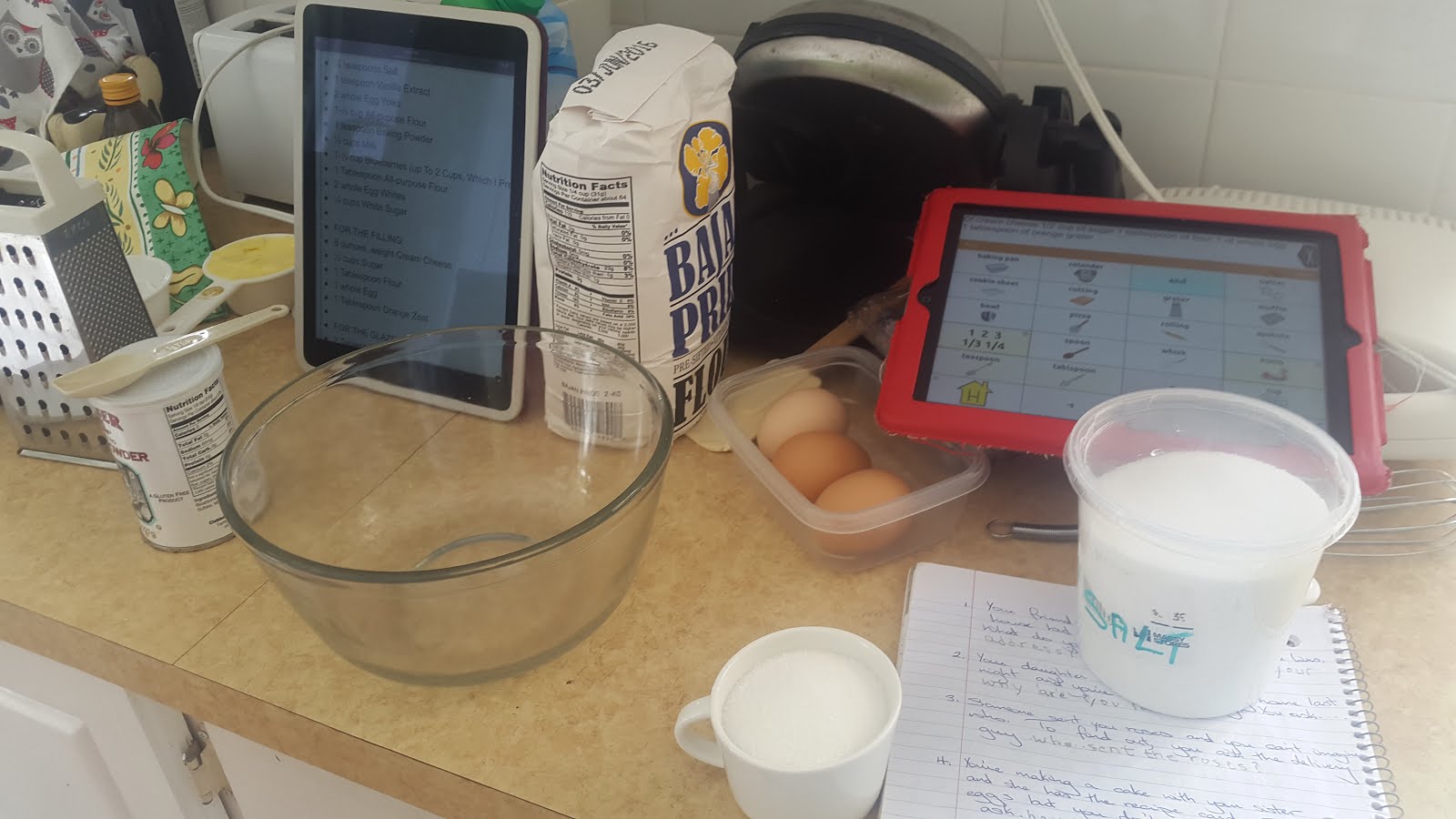
After which we worked on navigation of the app to talk about the ingredients and directions for the recipe, and made a shopping list for the family. It was easy to navigate through 1/2 teaspoons and 1/4 cups of ingredients using the app, and I also programmed a separate page called "baking actions", specific to baking activities.
 

The next session was baking day and the highlight of our therapy. I showed up wearing an apron with iPad in one hand and a whisk in the other, ready for some AAC baking action.
She took the lead as head baker and supervisor, using the device to give directions, and ensure accurate measurements (as well as to ensure I didn't mix up salt for sugar *hide face*). I mixed, beat, stirred, and poured away under the best instruction. 


There was also great fun in licking the batter from the bowl. Yumm!

Our hard work was definitely worth it, since her willingness to independently use the device to initiate and communicate was amazing, plus the finished product was on point :). 


So the answer to the title question is Love. Love is baking delicious goodies, while effectively using AAC for functional awesomeness! 


Wednesday, June 10, 2015

Articulation & Phonology in Scribblenauts Land

This isn't an app review, but more of an Aha! moment....

I am a huge fan of Scribblenauts. I am absolutely fascinated by the fact that you can type in pretty much anything and they create it instantly and can spend way too much time playing it at home in therapy with my clients. I love the fact that it works on so many language goals, critical thinking and problem solving skills, making inferences, and everything else you want it to do. When I saw a level show up as an "adjective level" I was over the moon.

#win

My dilemma came when a little one showed up on Monday demanding Scribblenauts for his artic therapy. Seriously they always want me to be creative on the spot! Anyway I thought for a bit and came up with the photos below to work on his "sh" sound.


Honestly I had to thank him for this one, because we have never had so much fun in Artic Therapy. We had great sentence level productions with the "chef on the ship", the "shell that fell on the shark," the "angry shark that attacked the chef" (and killed him.....sorry it got a little violent).  He was able to think of his own "sh" words and silly scenarios and we really targeted those sounds. 

After this session I was so excited to use it all through the week, both in artic therapy and in cycles at single word level. We made pictures for multisyllabic words, velars, clusters, everything. Now I'm hooked.  Another fave was my "farm in the forest." The frog in the picture was actually a farmer who got attacked by the evil fairy and got turned into this with the magic wand (not my fault). 
So I'm loving it. Check it out and use it for articulation & Phono therapy in the free play level. Let me know how it goes! 

Sunday, May 31, 2015

Sort this Out Pack - Review with Giveaway

It has been a while since I've done an app review, so when my friends over at Therapy Box  asked me to review one of their apps for Speech Therapy I just couldn't say no. It's a perfect app for us speechies as we head into a few months of summer fun, since I personally love summer time to really focus on categorization skills. These are some of the targeted language skills that are great for my summer groups.

Sort This Out Pack is an app which is designed to help work on children's categorization skills. Apps for categories are always a handy addition to any therapist's toolbox, since not only do they work on categorization skills, they also expand receptive and expressive vocabulary.  This colorful, and interactive app has a train theme (Who doesn't love trains?) where the train pulls into various stations; the beach, city, zoo, and theme park (The zoo animals are the cutest)


After a truck unloads the cargo boxes at each station, the train enters for collection, and the goal is to sort the items into two categories, which make up the carriages on the train. What I really like about this app is that you can customize your categories in the "Settings" panel, and chose what comes at each station. The set categories are ocean, weather, fruit, vegetables, animals, transport, kitchen, bathroom, bedroom, tools, shapes, drinks, sports, body parts, plants, toys, cleaning, music, school, house, insects. Plus you have the option of adding your own categories using your personal photos. There is also a button to record your own voice to label each photo.


Another useful feature that can be customized when interacting with this app is the type of prompts provided. You can turn on auditory or written cues to add support where necessary.

I've been playing so far in "errorless" mode, where if you drop an item into the wrong carriage it will bounce back to the bottom of the screen to let you know that it doesn't belong there. However, there is also the option to turn this off, and then a blue symbol will appear to show which ones do not belong in that category.


At the end when all the items are in their correct categories, players are treated to a fireworks display and a "well done" from the conductor as the train moves off to the next station.

There is also a "results" page, which allows you to email results from each station for your personal records.

I've really been enjoying using this app so far, and it has been well received by the little ones in my practice. They love filling up the train, and I've also transferred it to my Thomas train set activity which allows us to sort items around the clinic.

As a therapist what I would suggest to the developers is the ability to add more categories. This way, as children master this level there is the opportunity to have 3 or 4 categories at one station, to make it more challenging.

If you think that this app sounds like it's for you, you can pick it up here on the iTunes store.

Our lovely friends at Therapy Box were kind enough to provide a copy for me to give away.  You can enter below with Rafflecopter. The winner will be announced next Tuesday!

*UPDATE* We have a winner!! Congrats to Kathleen for winning a copy of Sort This Out Pack App. I hope you enjoy using it in therapy!


Tuesday, March 24, 2015

Functional? Reflections of a Therapist

For these moments when my mind rambles into a Facebook post, and I think to myself...."Hey that's a blog post right there...." 

Quick(ish) post between office work tonight, as I reflect on my day, and some of the 'awesomeness' that was created today in therapy (like some good old chocolate chip cookies....but I digress...). Today made me think about how many accommodations we as therapists make for our clients within the clinic setting. We try to present 'real life' scenarios that in reality are so far from real life....since sometimes without even realizing it we anticipate the difficulties a client may have, and make certain accommodations, provide the supports to suit. It's only when we place them in real world, true functional situations, that we realize how tough it really is in the world. I see this particularly with my patients with aphasia. Today for example we worked on a goal of calling places to find out certain types of info (mainly as it relates to numbers, since this is a goal). We practiced in a 'role play' first then made the calls, and it was only then that I realized how much I was, slowing down, and emphasizing the target information that she needed to find out. I also was more aware of how quickly people in customer service speak, and rattle off numbers (Not even mentioning factors like background noise etc.). Anyway Kudos to the persons at the companies I called today! They didn't have a clue that this was a therapy exercise, nor that the person not the other line had suffered a stroke, but still remained patient, slowed when they realized they weren't being understood, and made sure they clarified all the relevant information.  #foodforthought


Wednesday, November 5, 2014

The Aphasia Group

Today, I had the pleasure of hosting my first Aphasia group, with two young ladies who had suffered from strokes within the past few months. They both have moderate aphasia, with only mild comprehension deficits, nonfluent speech, difficulty with confrontation naming, and significant word finding difficulties.

This was the first time they had ever met, and you could tell they were both quite nervous. However, as we were doing the icebreaker activity, when one started to talk, the other suddenly exclaimed "She talks like me!!!" and they both burst into giggles. That was all the icebreaker they needed. They had a lovely session, where they encouraged each other, helped cue each other (I was like who's the therapist here now?), gave high fives, and even ganged up on me. It was so good to have that support of someone who was experiencing the same difficulties, who could be patient while waiting for them to get out the right words, because they knew the frustration of knowing what to say, but just not being able to get those words out. Hearing things like "It's ok I have that problem too," "Come on, you can do it," "Don't give up," made me so proud of these two. We were able to do so much more than in an individual session, for example individual therapy sessions are usually based on answering questions, and today I was able to tap into difficulties/strengths in asking questions. By the end of the session they had created a new friendship, made me take their photo together, and exchanged whatsapp information to maintain contact. It was such a blessing to be able to not only help them regain their language skills, but also to provide for them the support of another person who truly understands what they are going through. I'd recommend for any therapist to host an aphasia group and see the impact it has on your clients, and also on you as a professional, and a person.

Session Format:

1. Icebreaker- Participants were required to take turns asking each other and asking questions about themselves. Questions chosen ranged from "what is your name?" to "Do you have a boyfriend?". (They chose the questions not me).

2. How do I feel when….? (Talking about the impact of their stroke, how it has affected their lives)

3. Guessing game- Used functional pictures from the LARK  and played a game where one had to use the strategies they have been learning in therapy to describe a picture of an object (e.g. what does it look like, what is it used for etc.), and the other person guess what it was.

4. Feedback on session

Tuesday, October 29, 2013

Quickly Blogs and runs away

Haven't been here in forever. However a post I made on fb today gave me the idea to do quick posts of things I'm doing or seeing in therapy. Will try that. I'm on instagram as well these days showing off my speechie life as @speechreka. There are also some fashion, photography and posts of my general day in there (Hey I am a real person), so you can weed through those. Here's my speech musing today:

I had long convo with an SLP in the USA who called me to get some therapy ideas for her little ones. When chatting with her it made me think about the artic/phono targets that many of us choose for our little ones, particularly those with motor planning difficulties or low tone. When moving up to 2 syllable words many of the popular workbooks give an interesting list of words such as cowboy, pizza etc. which need wider phonemic repertoire and greater motor sequencing ability to produce. I prefer to start with nice reduplicated bilabials (which also have good functional relevance language wise) like bye bye, mummy, bubble, boo-boo, puppy, baby, and include happy, apple, open. I find littles with Down Syndrome find it more challenging to produce multisyllabic words, and expand their utterances in general. These words come in quite handy for this and can be used to build a range of semantic functions (bye-bye baby). What say you speechies?

Monday, October 29, 2012

Once upon a time

I love working on narrative and looking at narrative development in children. It's something that I find many speech therapists tend to shy away from, but it is such a valuable tool. I had a lecturer and clinical supervisor who was very passionate about narrative and story grammar markers and all the fun stuff that goes along with it, and I ended up doing my Masters thesis on how 5 year old children tell stories. Here I looked at how children used a wordless picture book (One Frog too Many) to retell a story.
Through my thesis work and my clinical practice I have seen how informative narrative assessment can be, to critically evaluate a child's vocabulary knowledge, ability to relate events that happened and sequence events in logical order, use of appropriate syntax, ability to give clear descriptions, use of connectors, use of inferences and prediction, use of connecting words, referencing using pronouns, auditory memory, and so much more. It is fascinating to see how children of the same age can vary from giving very basic picture descriptions to producing true narratives filled with expanded details and  direct speech.

When I did my thesis I based much of my analysis on a narrative assessment which was a favorite in the University clinic by Black Sheep Press. This assessment called Peter and the Cat Narrative Assessment, is a norm referenced test which, after supported analysis gives an excellent descriptive profile for key language areas in narrative development. It also allows for planning goals for intervention in therapy.  It's a very interesting story, with beautiful illustrations about a boy who tries to rescue a cat from a tree and ends up being stuck in the tree, needing rescue himself. This allows for all the story grammar markers to be used: Setting, initiating event, response, plan, resolution, coda and gives you examples and guidance on how to transcribe and score them appropriately. It also looks at features such as story content and structure, vocabulary, connectors, adverbials, referencing and story register in the analysis. Couldn't get any better right?

Well it has!  I found out a few weeks ago that they made this amazing assessment into an iPad app (*fistpump*) ! It has the same cool features, great graphics and it's a very handy portable assessment tool for therapists. Guess what I downloaded quickly and have been using all week with my little ones! You can choose between male or female narrators with different accents, and it allows you to store each client individually, with their own recorded story and report. It also has password protection to ensure patient confidentiality of files. The pages turn like a real book, and I found the children were more engaged and focused during the assessment for both listening to the narrator and the retell.

Another good thing is that you can choose to exit the program and come back later to transcribe (who has time to transcribe the same time) and complete the analysis. Each page gives you the same descriptive profiles as the hard copy of the assessment and provides guidelines for analysis, then it compiles it all into a report for you to email and print for your records. How neat is that! The price of $49.99 I find is pretty reasonable for an established assessment, especially for the type of analysis it provides.

So if you're looking to venture into the wonderful world of narrative assessment and intervention give it a try!


Wednesday, September 19, 2012

Yo Ho Ho and a Bottle of Bubbles!!

Far far away on a small island in the Caribbean sea, it wasn't business as usual for one of the schools, as a crazy (by general consensus) Speech Therapist marched up and down shouting strange things like "Arrrrgh" and "Ahoy Mateys" and singing "Yo ho ho and a bottle of whatever came to her mind!" Just as they were deciding to make that call to finally give her the help she needed..... they learnt that it was Talk Like a Pirate Day!!!!

Shiver me timbers! First off I must say that I wasn't planning to talk like a pirate today, nor did I even plan to observe the day's existence. However the constant pirate tweets by @lessonpix and the @speechdudes, as well as an excellent blog post  from lesson pix with great tips for the day, got me hooked (giggle).

I headed for my toy cupboard and collected all the treasures I could find. Unfortunately I didn't have any pirate garb lying around, so this was what I came up with in the end.

And off I went to school, where I worked with children aged 14 months to 10 years. The highlight of the day of course was pop up pirate, which I used to target a range of skills, for individuals and groups. It went surprisingly well with my 4-6 yo group who are working on awareness of others, attention and listening, and turn taking and we had lots of fun. 
I had another group of little boys between 3-5 who are known to be runners and roamers, and our main focus is engagement, maintaining joint attention, imitation skills etc.  That group marched around the room with me shouting "Arrrgh" and "Yo ho ho. (and a bottle of bubbles)" They also enjoyed group favorite no. 2: putting the pirates on the pirate ship and sailing it across to each other :) 

I wondered to myself how I would adapt my theme for my baby group. We ended up doing lots of mirror play saying 'arrrrgh' and making fun sounds, and played the Pierre the parrot app on the iPad, which is always all round fun. 
However some little ones didn't quite like my "arrrgh" so we had to rock and go "shhhhhh" instead. 

My highlight of the day was showing a teacher how she could use AAC in her classroom for the children to play an interactive game together. I found a great board from Boardmakershare, which really worked well for requesting and building vocab and the children loved it! What I loved is that this board didn't only have vocab for the game, it also had visuals for 'my turn', 'your turn,' 'high five'  etc. which made the interaction even richer :)  


                                            He especially loved my 'Arrrrgghhhhhh!'

So I had a fun "Talk Like a Pirate Day' and, despite the strange looks from some teachers, I think the children had a blast! 

Did you do anything fun today?? 


Sunday, September 2, 2012

The Wonderful World of Parachute Play

Me having lots of fun with a client yesterday


I'm always looking for fun new ways to keep children engaged and having fun while learning language, so when I was introduced to parachute play earlier this summer it became one of my top therapy tools. It is great fun for all ages, and can be used for individual sessions and with groups. With its bright colors and the ease with which it moves the parachute is an amazing sensory experience, particularly for those children on the spectrum.

If you don't know what parachute play is see here

My first parachute play experience occurred during my summer camp. I saw this lady's page being advertised on Facebook, and this was one of her party activities. I invited her in to do some of these activities with my little ones and I fell in love. She pulled out this huge parachute which she spread across the lawn and everyone was instructed to hold the many handles. We worked together to lift the parachute "up and down" "fast and slow" "shake shake shake" from side to side, listen for "stop and go," shake to the beat of a drum. Needless to say I was over the moon. She had me at 'shake shake shake.' She had lots of little songs to go with the activities which I was scribbling down quickly as we went along. There was one in particular about a little bunny, where she put the bunny puppet in the middle and everyone had to keep the parachute very still because he was sleeping, but then the bell went Ding-a-ling-a-ling and it was time for the bunny to WAKE UP, so everyone had to shake the parachute up and down to wake the bunny.

Another activity was one where she put some toy animals in the middle under the parachute, then she made an animal sound and a child had to dash under the parachute and pick up the correct animal. How cool is that!

My favorite was the popcorn game where she put some pretend popcorn in the middle (I think she got this from Lakeshore, later I recreated this with styrofoam chips), and went through the popcorn story where the parachute was a BIGGGG pot, you had to pourrrrrrr in the oil, shake shake shake the salt etc. then stir and stir and stir, then it starts to get reaaalllyyyyy hot (don't touch), then the popcorn starts to pop pop pop and you shake the parachute up and down to make it pop.  This was a big favorite with the little ones.
There were a few other ones that I liked, including everyone running under the parachute on a signal, and one with putting body parts over and under.
What amazed me was the level of engagement from children across a range of capabilities. Children who I would consider the most difficult to engage in sessions were taken up in the the activities and so fascinated by the parachute. Therefore you know what I did next.....I went here:

So now I have my own parachute. Which I have started to use a lot in individual sessions, mainly with the toddlers to start, for peek a boo and other engagement games and playing 'up up up...down.' I find the 10' is a good size for both individual and group sessions. We've been having a great time with it and I'd recommend it to any therapist looking for new tricks to keep children engaged :)


Sunday, August 26, 2012

Dusting off the Cobwebs.....Realtalk

Hey everyone! Yes I am still here.

Yup months later I'm dusting off the cobwebs off this blog, shaking it up, and promising to write more often. Honestly I've been trying to organize and compartmentalize over the past few months. Those who know me know that the wheels in my head are always turning, most of the time too fast for me to catch up with. With running a practice, a blog, an app, slpchat, a magazine and everything else in my life it was time to put some things on hold and refocus. Unfortunately my twitter time has reduced significantly since these changes have happened and the blog posts have reduced to almost nothing, but I'm a work in progress, so hopefully that will change in the coming months.

I've decided to put all my focus right now into my practice. Those who are in private practice know that  it is TOUGH! I've found myself struggling and feeling absolutely overwhelmed in recent months, managing clients, admin work, accounts, keeping up on all the current trends, research, apps, everything. I've been forced to turn into superwoman! In a country where there are only 4 SLPs, to say the demand is high is an understatement, and that's where caseload management becomes difficult. Remember in grad school you had to sit with your tutor after a clinic session and reflect on your performance? What went well, what didn't go so well, what you would do differently next time. You need to constantly be doing this in your practice It's not just evaluating your patients' performance and progress, it's about looking at your performance and personal growth as a therapist and in some cases a business owner. A few things came to light in my reflections which I decided I would share:

1. Quality beats quantity anytime! It's better to have 5 patients that are getting the best service that you can possibly give, than to have 50 that you're not giving your best to.

2. There's a point when you have to say No (and stick to it), or at least a 'not right now.' People may get angry, but you can't please or help everyone. Your practice will be better if you don't take on more than you can handle. If people respect that you want to provide an excellent service they will understand.

3. Ask for help! There are people out there that have been doing this way longer than you have. Find out how they are managing everything. What strategies are they using to handle caseload management, deal with paperwork, stay on top of reports etc.

4. Realise you can't do it all on your own. Since hiring a personal assistant life has become so much easier. Delegate some duties, the time you're laminating those PECS pictures you could be planning some goals.

5. Set aside specific time for your professional development. I try to do at least an hour on Mondays, Wednesdays and Fridays. Speechpathology.com now has some of their seminars in podcast format, which I like to listen to in the car or at the gym.

6.  Improvise! I was having difficulty writing up session notes on the days that I was moving from house to house for visits. I then started to record my spoken notes on my phone's voice recorder (to store in a secure place) in the car on the way to the next patient so that it would still be fresh in my memory to write at another time.

7. Remember to still have a social life! It's important to maintain that balance between work and personal life. Take a break from writing those reports and go have a drink (However don't write reports while under the influence.....)

Hope those tips are of some help to someone reading. I have a couple blog posts in my head that I'd love to share, so hopefully they come soon :) Also look out for the newest issue of EasySpeak Magazine due to release next month. This magazine is my favorite hobby right now and I'm glad that it has been so well received across the field of Speech and language therapy/pathology :)

Monday, January 16, 2012

Making Sessions Functional!

You know those sessions that go really well, just as you planned them in your head? I know, I know we don't have them very often, but when you actually do isn't it magical.
I had one of those sessions today so I decided I had to write about it and share with you.

My patient is a 7yo, diagnosed with ASD. He is verbal and I'd say quite high functioning, but he has lots of difficulty coping within social situations and with higher language tasks. His play skills are also delayed for his age, particularly when it comes to symbolic/imaginative play. I've been trying to incorporate lots of his language tasks into many functional play activities that relate to his everyday routines. Today we worked on going grocery shopping.

We played a quick barrier game using the supermarket theme in the Magnetalk Match up adventures kit, to work on following directions and building vocab, amongst other goals.

We also talked about why we go to the supermarket, and the types of things we buy at the supermarket.

I found the perfect link for him, a video which actually shows a pretend play routine for going to the supermarket, so we were able to watch the video and model the steps. I loved that the video used pretend items for the activity, such as balls for fruits, and laundry baskets for shopping carts. We watched the video and made a visual timetable for each set.

It was then time for us to go pretend shopping. We drew our shopping list and looked around the office for items which we could use in our activity. A doll pram served as our shopping cart, balls were our fruits, and some empty jars for our milk, juice etc. Then it was time to go to the 'cashier' - a word modelled repeatedly to make sure he got the concept. We took turns being the cashier so that he could get an idea of both processes. Please remember to note "unload the groceries" as a step, since we tend to jump from putting the items in the shopping cart to going to pay. This is an essential step to note. I got a cool toy cash register that lights up and makes sounds for christmas so it was fun to use. We took turns scanning each item and deciding on suitable prices for them. Then we talked about how it mummy might pay with either cash or a credit/debit card, so we used a different method on each turn. After that we got the receipt and put the items into the bags to take home.

What I love about the adventures kit is that there are worksheets for extension activities that cover a range of language areas. Mum got the worksheets for the grocery shopping theme to carry home and work on. She also has the task now of taking him to the supermarket and talking him through the same visual schedule that we made.

It was a fun afternoon and I hope you can use it sometime in your therapy activities :)

Saturday, January 14, 2012

New Year's Top 5 Toys

Happy New Year!!!!
My how the time has flown. I can't believe it's 2012 already.
I've just returned from a lovely vacation with the family in Florida and started work this week with lots of new energy. It's only when I started this week's sessions that I realized how much I missed my patients. Also funny is something I realized on my way back home from my trip. You know you're a speech therapist when one suitcase is filled with all toys and therapy materials.
I went crazy this Christmas with all the pre and post christmas sales on toys. I also think I bought out the whole of superduper pub. That company is going to drive me to bankruptcy!!! My assessment to buy the year was the MAVA. which I used for the first time last week and loved. I also bought the Magnetalk match up adventures kit, which finally went on sale at 50% off! I've wanted that one for a while!

I thought that to begin the year I'd share with you my top 5 toy buys to kickstart the therapy year
and maybe some quick ideas on how to use them in therapy.

1. Zippy Mat Hit the Moles Play mat (can be found here )
I snapped this one up at Publix, on 75% sale and paid and ran before they changed their minds. This was a steal at $6. This is an interactive mole that lights up, and the goal is to hit the moles' noses as they light up to score points. I've been using it mostly as a reinforcer/break between activities. Children say 5 target words then try to hit 5 moles etc. This one is a hit with everyone. It's also very interesting to see those children with motor planning difficulties struggle to hit the moles.

2. Frog in a box
Another HUGE favorite for me. I saw this last year in a Hanen video while I was doing the ITTTT program and fell in love. I've been searching for it ever since and finally found it here on Amazon this Christmas. It is the perfect cause and effect toy! What I love is that the frog actually pops right out of the box and lands somewhere nearby which the children are not expecting. It's a bit pricey to be honest, but definitely worth the money. I've built a routine with the box singing:
What's in the box
What's in the box
Tell me Tell me
What's in the box

Then we 'oooooopen' and 'POP' goes the frog ("Uh-Oh, you naughty frog") then we say "bye bye frog" put it back in and say "shut". Lovely language building activity.


3. The honking pig
Another one that makes me giggle. This is a nice switch adapted toy for teaching children the cause and effect relationship for initial switch use. I've been using it with my big mack device and laughing every time it walks, grunts and wags its cute little tail. If you're hooking it up to a big mack or big talk device you will need a 1/4" to 1/8" adapter to fit it. Make sure the company sends it the same time. Don't learn the hard way like I did. It's so amazing to see the little ones making that connection and looking from the switch to the toy as they press.

4. Wind up toys
Every speech therapist should have a set of these in a ziplock bag in their therapy bags. I found mine on sale at walmart for $1 each on boxing day and bought about 6. My favorites are the caterpillar, train, dinosaur and butterfly. I found a great idea in the Teach me to Talk manual about putting them in see through ziplock bags and to open give a long exaggerated zzzzzzzzzzip, while slowly pulling it across, then give the child a chance to do the same. Great also for imitation and fine motor skills.

5. The laughing monkey
Another cause and effect toy that makes me laugh. I picked this up during a long layover at MIA (Yes I'd find a toy store anywhere). I love it for maintaining attention and for shared attention. It works a treat with a little toddler I have with TBI who has difficulty maintaining attention. It also keeps the parents laughing in therapy.

So there you have my top 5. What are your favourite toys to use this year in therapy?

Thursday, November 17, 2011

Have you heard about Nuffield?

If you as a speech therapist/teacher haven't heard about The Nuffield Centre Dyspraxia Programme (NDP3) as yet you need to ask someone quickly!

I learnt about and used Nuffield in grad school. My favourite tutor believed in the programme, particularly for use with children with Cleft Palate, and she passed that obsession with the program onto me. I use it pretty much every day for children with a range of speech disorders, and the images of "Popeye picking poppies" never get old (If you've used Nuffield you know what I mean).


The NDP3 website summarises the program as:
  • suitable for any child with a speech disorder.
    blank5
  • a complete resource, spanning pre-speech to connected speech levels.
    blank5
  • Provides for parental/school involvement in therapy.
    blank5
  • most suitable for the 3-7 year age range but can be adapted for younger and older children.
    blank5
  • Affords great therapeutic flexibility.
    blank5
  • Provides detailed guidance on planning and management.
    blank5
  • Is 'clinician-friendly.'
    blank5
  • Ensures that therapy remains fresh, engaging and stimulating.
What I love about it is that it is a complete program, from assessment to intervention. It allows you to move from sounds in isolation to connected speech, giving guidelines all the way. The sound sequencing pages are perfect for children with CAS! What's also important is that the phrases and sentences are functional; working on negatives, possessives, everyday phrases etc. The sound stories are also fun! Check out the sample pages!

My only criticisms however, were that I would have loved the pics in colour, and a way to edit them to get specific sounds/words for each individual child.

You could imagine then, that when I heard about their new speech builder I was over the moon.

It has all the pictures from the Nuffield Program PLUS Jolly Phonics pictures! (Yea I got a bit excited there) and it allows you create your own worksheets, customise, and colour as you so desire. Needless to say I have been using it constantly in therapy. I've been even incorporating worksheet making into sessions, and the children love being able to create their own 'speech pages.'

All the info you need to know about the NDP3 Speech Builder (including demo video) can be found at http://www.ndp3.org/speechbuilder.html, and the original Nuffield at http://www.ndp3.org/.

Let me know if and how you're using Nuffield in therapy and what you think of the new program!